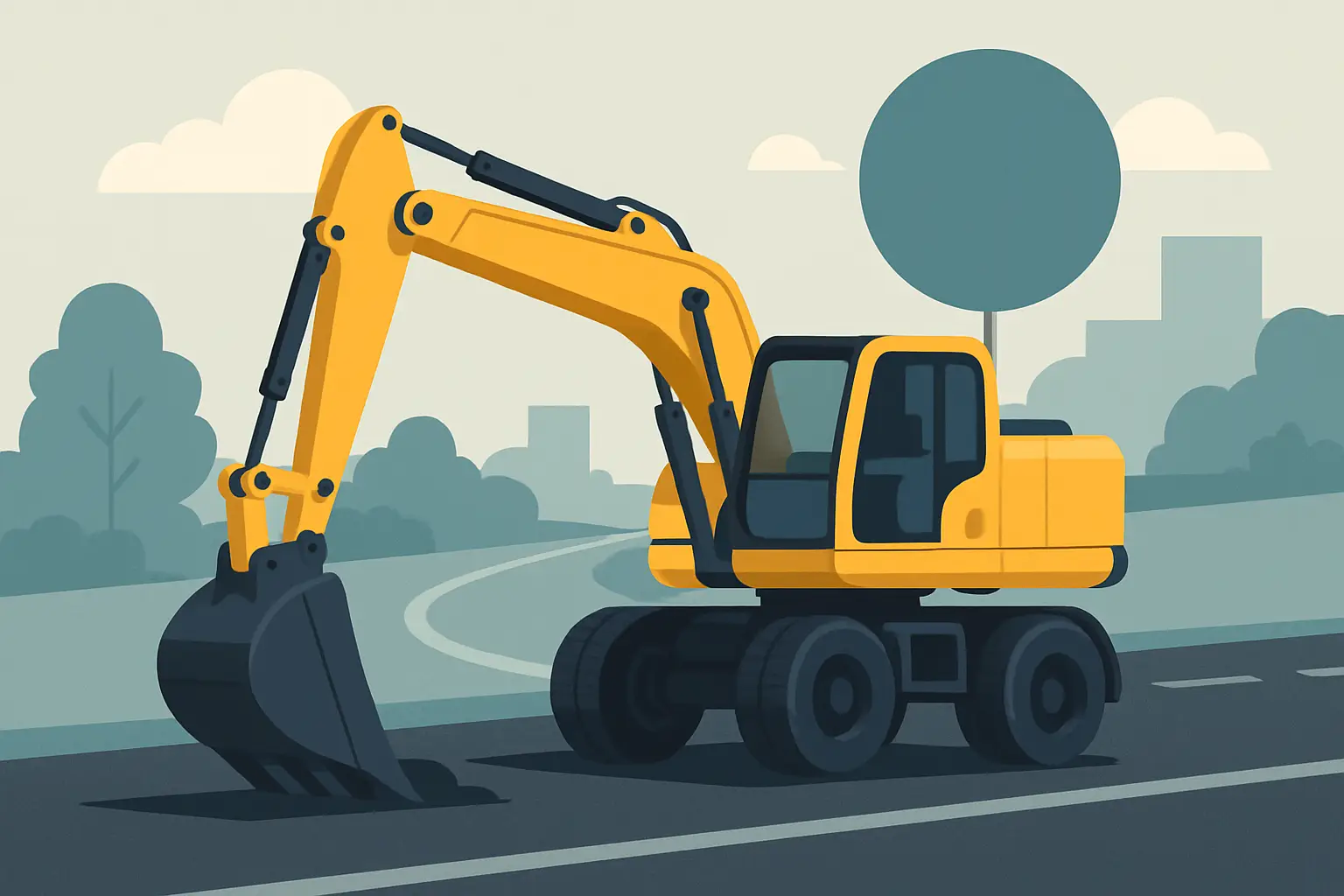
If your crew spends half the shift waiting for a low-loader, a wheeled excavator starts to look less like a "nice to have" and more like a productivity fix. Road work is stop-start by nature: moving between short workfaces, working around live traffic management, and coordinating with surfacing gangs, utilities and deliveries. A machine that can travel under its own power, set up quickly and work cleanly on tarmac can take friction out of the programme.
A wheeled excavator for road works is not automatically the right answer, though. The same mobility that makes it attractive also changes how you spec the machine, how you plan attachments, and what you must verify when buying used. The best results come from matching the excavator to the reality of your sites - not the brochure.
Why a wheeled excavator fits road work (and when it doesn't)
The core advantage is simple: you can reposition quickly without a transporter for every minor move. That matters on highways maintenance, local authority schemes, and utility reinstatement where you might work across multiple locations in a day. Less plant movement also reduces booking pressure on haulage, and it can help keep you inside tight possession windows.
On paved surfaces, rubber tyres are kinder than steel tracks. You reduce scuffing, you cut down the need for protective mats, and you keep the work area cleaner - a practical win when you are operating in public spaces where appearance and housekeeping are scrutinised.
The trade-off is stability and ground pressure. On soft verges, made ground, or poorly compacted backfill, a wheeled machine can struggle where a tracked excavator simply floats. It is not that one is "better", it is that road schemes often include both firm carriageway and unpredictable shoulders. If your work regularly moves off the pavement, you may need to spec stabilisers and blades carefully, accept slower cycle times, or even split the fleet - wheeled for carriageway tasks, tracked for off-road sections.
Typical road-works jobs where wheels pay back
A wheeled excavator earns its keep where the work is repeatable and travel time is real. Think of drainage repairs, kerb lines, footway reconstruction, ducting and cable installation, gully replacement, and small structures where you are constantly shifting position. They also perform well on urban schemes with tight access, parked cars, and frequent set-ups, especially when you need to load lorries from the road without tearing up the surface.
For heavier demolition, bulk excavation, or deep trenching in soft ground, you can still use a wheeled machine, but you are asking more of its undercarriage and stability. In those cases, the correct configuration and operator discipline become the difference between smooth production and a machine that feels "on tip-toes".
Key specifications that actually matter on roads
Operating weight and reach
For general road and utility work, many buyers sit in the mid-range class because it balances lift capacity and manoeuvrability. Too light and you lose confidence when lifting rings, trench boxes or pipe sections; too heavy and you begin to fight access restrictions, axle loads and transport constraints.
Reach matters as much as weight. On a live carriageway you often want to dig from a safe position, keeping tyres away from open edges. A longer dipper and a sensible boom configuration can reduce repositioning. The wrong geometry forces you to creep closer, which can create edge break or compromise safety margins.
Tail swing and road space
Conventional tail swing is workable on open sites, but road works are rarely open. Reduced tail swing or short radius designs can help you operate within cones and barriers without constantly stopping traffic management to create more room. The cost is often a slightly different feel in lifting and stability, so match it to the operator's experience and the tasks you do most.
Outriggers, dozer blade, or both
For road works, stabilisation is not optional. A wheeled excavator typically relies on outriggers and, on many models, a front blade. The practical question is how the machine will spend most of its time.
If you are lifting frequently (manholes, chambers, pipes, barriers), solid outriggers with good pad condition and responsive hydraulics are essential. If you are grading and backfilling reinstatements, a blade earns money daily. Many contractors prefer both, because it gives flexibility across patching, trenching and lifting without changing machines.
Drive speed and towing considerations
Travel speed looks attractive on paper, but on UK roads your movement will be governed by site rules, escort requirements, and common sense. What you really want is predictable, smooth travel between workfaces, with steering and braking that feel controlled under load.
Check whether you will tow a roller or small trailer within site boundaries. Some wheeled excavators are used that way, but it is job-dependent and must be managed within safe working practices. If towing is part of your plan, spec and condition become even more critical.
Hydraulics for attachments
Road work is attachment-heavy. A machine that is perfect with a bucket can become frustrating if the auxiliary hydraulics are under-specced or poorly set up. Confirm flow and pressure for the tools you actually use - breakers, compactors, grabs, tiltrotators, planers, or augers. Also check whether the machine has the correct pipework, quick coupler type, and any required electrical lines for modern attachments.
Choosing the right attachments for road works
A wheeled excavator becomes a road-works workhorse when you treat it as a tool carrier, not just a digger. Most fleets will run at least a grading bucket and a trench bucket, but the real productivity jump often comes from a tilt bucket or tiltrotator for shaping and finishing without constant repositioning.
Breakers are common for carriageway openings, but breaker work is hard on pins, bushes and hydraulics. If breaker use is frequent, condition checks and maintenance history become more important than year. A compaction plate can improve reinstatement quality, while a grab can speed up handling of kerbs, pipes and spoil segregation, particularly in urban jobs where space is limited and segregation is enforced.
Buying used: what to inspect so it turns up ready to work
Used machines make sense in road works because utilisation is high and programmes do not wait for factory lead times. The risk is buying someone else's downtime. A proper inspection should focus on the points that affect availability and compliance on road sites.
Start with the undercarriage and steering. Tyres should have even wear and no sidewall damage; uneven wear can indicate alignment or steering issues. Check the condition of wheel hubs, braking response, and any play in kingpins or axles. On a wheeled excavator, these components take constant movement loads, and failures can stop the machine immediately.
Hydraulics are next. Look for leaks at the boom, dipper and attachment pipework, and pay attention to the slew system and any hydraulic drift. Slow functions, jerky movement or unexplained noise can be early signs of expensive work.
Pins and bushes matter more than many buyers admit, particularly if the machine has lived on breakers or heavy lifting. Excess play affects accuracy when trimming back asphalt edges or working around services. It also accelerates wear on the rest of the front end.
Electrics and cab controls are not cosmetic on road works. Lighting, beacons, cameras and warning systems are part of working safely around traffic. If the machine is equipped with additional safety features, confirm they function properly. Likewise, check heating and demisting for year-round operation - downtime in winter is rarely down to the engine alone.
Finally, verify hours and service history where possible. Hours are useful, but they are not the whole story. A lower-hour machine with poor servicing can be a worse buy than a higher-hour unit maintained properly.
Compliance and site realities in the UK
Road schemes bring scrutiny. Emissions requirements, noise expectations, and client rules can dictate what you can put on site. If you work on council frameworks or large infrastructure projects, you may need specific emissions stages, additional guarding, or particular safety systems. This is where buying used requires discipline: make sure the machine you are considering can be deployed across your target work, not just one job.
Also think about physical constraints. Some sites have strict width limits, weight limits on structures, or access through narrow residential streets. A wheeled excavator is often chosen because it is easier to move, but it still needs to fit the route and the method statement.
What a good procurement process looks like
The fastest way to get a wheeled excavator wrong is to buy on headline price alone. The better approach is to specify by outcomes: the attachments you run, the ground you work on, the distance you travel between workfaces, and the safety kit your sites expect.
If you are buying through a specialist, insist on clear specs, hours, and a condition-led inspection that checks function, not just appearance. That is the difference between a machine that arrives and works, and a machine that goes straight into the workshop.
If you need a machine quickly without compromising on condition, a sourcing-led route can be effective because it widens your options beyond local listings. This is particularly useful for wheeled excavators, where the right configuration (outriggers, blade, boom setup, hydraulics) matters more than having any unit at all. AGRORIG LTD focuses on inspected used equipment and managed delivery, which helps reduce lead time while keeping the buying decision grounded in verified condition and clear specifications.
Making the wheels work for you
A wheeled excavator for road works is at its best when it reduces non-productive time: fewer low-loader moves, faster set-ups, cleaner operation on finished surfaces, and attachment flexibility that keeps one machine earning across multiple tasks. The only caveat is that you must spec for stability, hydraulics and site compliance from day one.
Buy the machine that matches your real week on site, not the one that looks good in the yard. If you do that, you will notice the difference where it matters - shorter programmes, fewer delays between tasks, and an excavator that stays on the job instead of waiting to be moved.