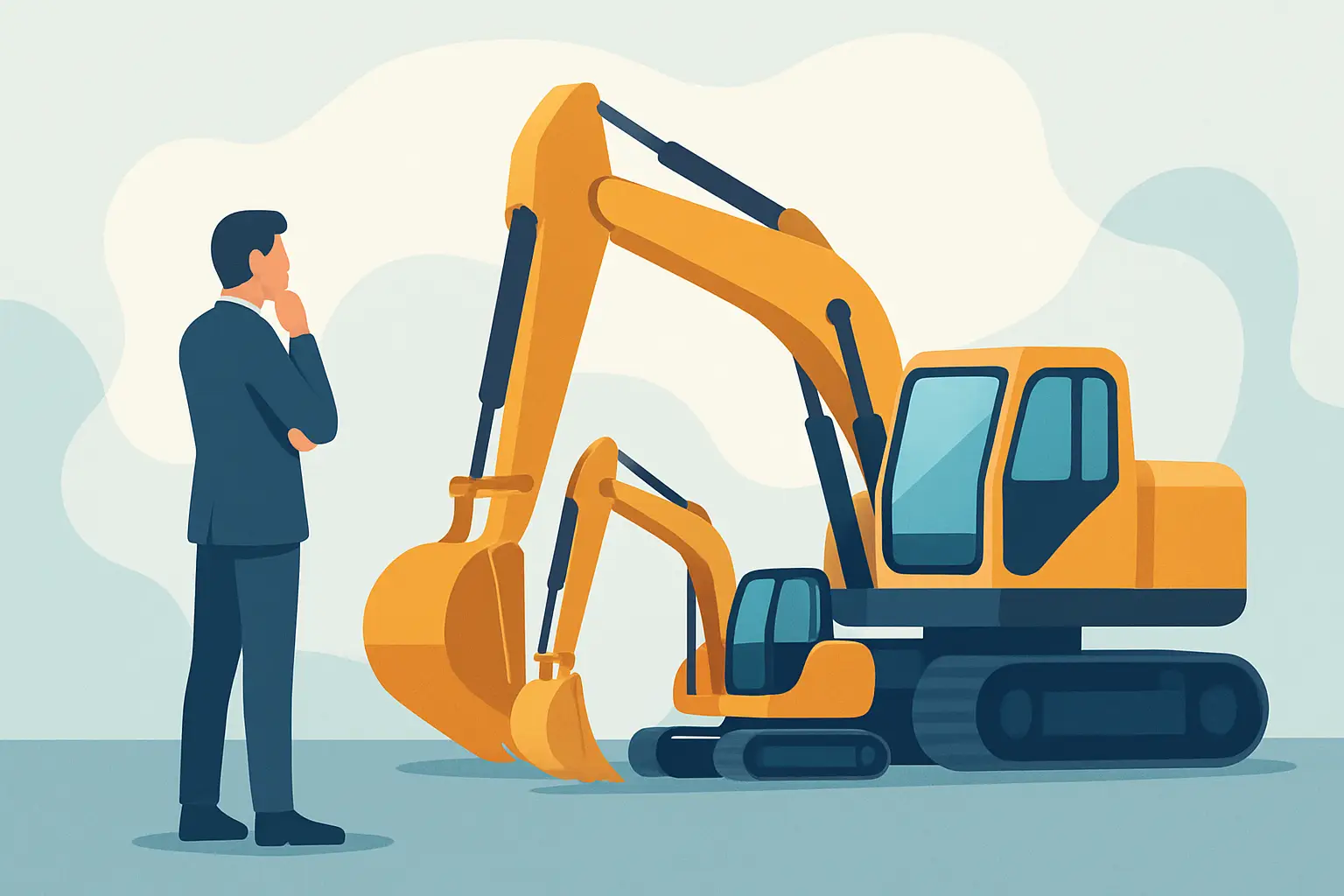
You can lose a day before the first bucket hits the ground if the excavator is the wrong size. Too small and you are cycling endlessly, overworking the hydraulics and burning time on repositioning. Too big and you are fighting access, ground bearing pressure, transport costs, and sometimes the client's own site restrictions. The most reliable choice is rarely "the biggest you can get" or "the cheapest available" - it is the machine that matches the task, the site and the way you actually intend to work.
This guide to choosing excavator size for job is written for buyers and site leads who need predictable output, low downtime and an easy path from selection to delivery.
Start with the job, not the tonnage
Excavator size is often discussed as "a 5-tonner" or "a 20-tonner", but weight class is only a shortcut. What you are really buying is a combination of breakout force, reach, lift capacity, stability, swing performance and hydraulic flow. Those traits drive production - and they also dictate whether the machine can physically work on your site.
A quick way to frame the choice is to answer three questions. What material are you digging or handling? What cycle time do you need to hit to keep the job moving? What constraints will stop you using the machine at full potential (access, ground conditions, lifting over the side, working next to structures, noise restrictions)? When those are clear, tonnage becomes an outcome rather than a guess.
Mini excavators (0.8-3.5 tonnes): access-first, high utilisation
Minis earn their keep where the site dictates the machine. Think tight residential builds, utilities, back gardens, footpaths, internal demolition, and farmyard drainage where you cannot afford to tear up hardstanding. Their biggest advantage is access and low disruption. They can also be moved quickly between small tasks, which is why they are common in hire fleets and on maintenance-heavy contracts.
The trade-off is reach, lifting and speed of bulk excavation. If you need to dig long runs of trench in heavy clay, a mini can do it - it will just do it slowly, and operators may be tempted to over-reach or work at awkward angles, which shows up in pins, bushes and tracks.
Choose a mini when you know the limiting factor is space, surface protection or transport simplicity. If your key constraint is output, stepping up a class usually pays back fast.
Compact midi machines (4-8 tonnes): the best all-rounder for many UK sites
For many contractors, this is the "do most things" category. A 5-8 tonne excavator can trench, load, grade, and handle a wider set of attachments without feeling outmatched. You gain stability and reach without the transport burden of larger machines, and you can often operate on tighter sites with fewer compromises.
This class is where configuration choices matter. A zero tail swing or reduced tail swing layout helps around walls and traffic management, but you may give up some stability compared with a conventional design. Track width options also matter: a narrower undercarriage may get you through gates, but it can increase ground pressure and reduce confidence when lifting or working on slopes.
If you want one excavator to cover mixed work - drainage, small foundations, yard works, landscaping and light demolition - midis are usually the first serious option to check.
Mid-size excavators (10-14 tonnes): productivity without full big-plant overhead
Once you are regularly moving volume, a 10-14 tonne machine starts to look efficient. You can run larger buckets, achieve better cycle times, and handle heavier attachments such as bigger breakers and compactors. On civils packages, this can be the point where the excavator stops being the bottleneck.
The considerations shift slightly. Transport and site access become more planned, and ground conditions matter more. A machine that feels fine on firm ground can struggle on saturated sites if you do not manage mats or track options. This class is often ideal for contractors who want real production but do not want to commit to 20+ tonne logistics on every job.
Standard excavators (15-25 tonnes): volume, lift and attachment performance
For bulk earthworks, deep digs, and serious loading, 15-25 tonne machines are the backbone of many fleets. You gain reach, stability, breakout force and hydraulic performance that makes attachments work properly. On the right job, this size reduces operating hours per cubic metre, which is where ownership costs are won or lost.
The downside is that any constraint becomes expensive. If the site only allows limited swing, if you are constantly repositioning due to services, or if you have to work off mats to manage ground bearing pressure, the theoretical productivity can disappear. This is also where transport planning and costs are non-trivial, and where a misjudged spec (wrong boom, too short stick, unsuitable tracks) can be painful.
Wheeled excavators: mobility and versatility on hardstanding
Wheeled excavators earn their place where travel between workfaces is frequent and the ground allows it. Highways maintenance, urban utilities, and farm infrastructure work often suit them, especially when paired with a hitch, blade and stabilisers. They can reduce the need for a low loader on short moves and can be easier to integrate with traffic management.
They are not a simple substitute for tracked machines. On soft ground they can lose traction and stability, and lifting performance depends heavily on how the machine is set up. If your work alternates between paved areas and soft verges, you need to be honest about how often you will be "off the road" and whether you will end up restricting the machine to avoid getting stuck.
The key sizing factors that actually change the decision
1) Dig depth and reach, not just bucket size
A machine can be powerful yet wrong if it cannot reach the formation without constant repositioning. Trenching long runs rewards reach and efficient swing angles. Deep foundation work rewards dig depth and stability. If you are working close to the machine, a shorter radius can be safer and more controlled.
Reach also affects how you load. If you are loading high-sided tippers or feeding crushers, the wrong boom and stick combination turns into wasted movement and spillage.
2) Ground conditions and ground pressure
Soft sites, peat, saturated clay and made ground are where "bigger" can quickly become "stuck". Track width, shoe type and overall machine weight determine ground pressure. You can mitigate with mats, but that adds handling time and cost.
A smaller excavator that keeps working consistently will often outproduce a larger one that spends time recovering, tracking around to find firm ground, or waiting for additional support plant.
3) Lifting requirements and working radius
If the excavator is doing lifting - manholes, pipes, road plates, grab work, placing culverts - you need to size from the lift chart, not from the dig spec. Lifting over the side reduces capacity; lifting at reach reduces capacity again. A machine that can lift the load "on paper" at a short radius may not do it safely at the radius your site layout forces.
If lifting is frequent, consider whether you need additional counterweight, a dozer blade, or simply a heavier class of machine to stay inside safe margins.
4) Attachments and hydraulic flow
Many buying mistakes come from selecting the excavator first and assuming attachments will follow. Breakers, tiltrotators, grapples, augers and compactors each have flow and pressure requirements. An excavator that is marginal on auxiliary hydraulics will run hotter, work slower and wear faster.
If your work relies on attachments, size the excavator around the attachment that drives revenue, then choose buckets to suit. It is usually cheaper to run a slightly larger carrier properly than to push a smaller one beyond its comfortable duty.
5) Transport and site rules
In the UK, the "can we get it there and offload it" question is practical, not theoretical. Machine weight, width and height can dictate low loader choice, route planning, escort needs, and whether you can access tight lanes or urban sites.
Also check site restrictions early. Some projects specify maximum machine weight, noise limits, or working footprints. If you buy for one contract and then find the next client has tighter rules, you can end up owning the wrong asset for your pipeline.
A simple selection workflow that avoids expensive surprises
Start by listing the top three job types the excavator must cover over the next 12-24 months, not just the next job. Then match each job to a required dig depth, typical lift, and the attachment you expect to run most. If two of those jobs pull you in different directions, that is your decision point: either pick the compromise size, or accept you need two machines or a hire-in strategy for peaks.
Next, map the tightest site you regularly work on. Measure gate widths, check typical turning space, and be realistic about where spoil will sit. Many machines "fit" but cannot work efficiently once you include swing and working radius.
Finally, decide what you are optimising for. If uptime and predictable output matter most, prioritise machine condition, service history and inspection quality. If cashflow is the key constraint, finance structure can matter as much as the purchase price.
Buying used: what to check when size is already decided
Once you are confident on size, used equipment is often the fastest route to getting a machine earning. The risk is not age on its own - it is hidden wear and mismatched specification.
Hours should be read alongside evidence of maintenance and the condition of undercarriage, slew ring, hydraulics and pins. A clean-looking excavator can still be tired if it has lived on demolition or breaker work. Conversely, a higher-hour machine with documented servicing and sensible operation can be a dependable asset.
Spec details make a difference too. Auxiliary lines, quick coupler type, pipework for tiltrotator, track frame condition, and bucket selection can save you weeks of retrofitting and downtime. If you are buying to work immediately, "ready to work" is not a slogan - it is the difference between hitting programme and spending the first month in the yard.
If you want support sourcing a specific size and configuration from trusted European suppliers, AGRORIG LTD can supply from stock or procure to requirement with a structured inspection process and managed delivery.
The choice that tends to pay back
Most fleets make money when the excavator is neither struggling nor tiptoeing around constraints. If the job is access-led, stay compact and protect surfaces. If the job is volume-led, move up a class and reduce operating hours. If attachments drive your revenue, size the carrier for the hydraulics first.
A good excavator feels slightly boring on the right job - it starts, works all day, and finishes the task without drama. Aim for that, and the rest of the project management gets easier.